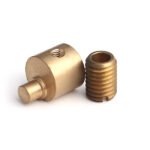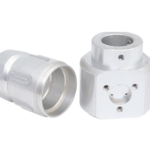


The material of the nuts is typically low-carbon steel with good weldability. Low-carbon steel, also known as soft steel, has a carbon content ranging from 0.10% to 0.30%. Low-carbon steel is easy to process in various ways, such as forging, welding, and machining. The advantage of welding nuts is that they are weldable and have relatively high strength, and they can be used in a wide range of applications, regardless of thickness. The disadvantage of welding nuts is that high temperatures can cause the components being connected to deform, and they cannot be removed.
The purpose of welding nuts is the same as that of riveted nuts, both of which are used for internal threads in sheet metal. However, the principles behind them are vastly different. Riveted nuts rely on the tooth-shaped embossing on the head and the interlocking with the sheet metal substrate for fixation. The precision of riveted nuts and the force of riveting can all lead to loosening of the riveted nuts. Welded nuts, on the other hand, are welded using spot welding technology. While installation is more cumbersome, the welded nuts are highly secure and less likely to detach after welding.
Although the strength of welded nuts is high and they are difficult to loosen, there are still some matters to be aware of during their use in order to ensure proper connection with welded nuts. Welding refers to the process of combining two separate components into a single unit by melting the metal at high temperatures and mixing it together before cooling. Alloys are often added in the process, and the internal structure is governed by molecular forces, which are stronger than those of typical nuts. As a result, welded nuts are widely used.