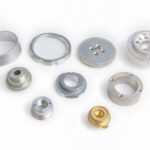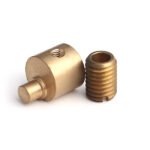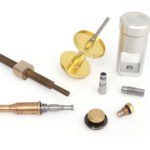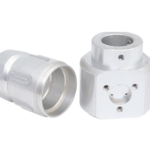


The precision component series has now become one of the most widely used types of nuts on the market. However, many people who use them encounter various problems. Below, I’ll guide you through the correct methods for operating the precision component series.
1. The typical application of nuts is to be welded onto thin plates with a thickness of around 6 mm. This approach helps prevent significant deformation during welding and results in aesthetically pleasing weld seams after welding.
2. Direct current should be used during welding, with the negative terminal connected to one end of the welding wire.
3. Any oil stains, rust, or other contaminants on the welding area should be removed before welding to prevent the formation of welding porosity.
4. Argon gas with a purity of 99.99% should be used as the protective gas. The flow rate of argon should be 8–10 liters per minute when the current is between 50–150A, and 12–15 liters per minute when the current ranges from 150–250A.
5. During welding, it is essential to maintain good ventilation in the working environment. In indoor settings, attention should be paid to air exchange. Additionally, welding must be performed with protective screens in place.
6. During the welding process, the angle between the welding area and the tungsten electrode’s central line should be maintained between 80-85°. This approach offers advantages in terms of better protection of the weld pool.
7. The angle between the filler wire and the welding surface should be kept below 10°.
The length of the tungsten electrode protruding from the gas nozzle is around 5 mm. The length at the corners or other more exposed areas is controlled to be around 2-3 mm. The length in deeper areas should be longer, around 6 mm.